

Ming-3.0-tts
A locally runnable expressive TTS from Ant inclusionAI with director‑mode control, supporting 7 languages plus Cantonese and Sichuanese.
Note: Please open in the PC Client. Go to download >>>
Features
Supported Languages
Dialects
System Requirements
Minimum 16GB RAM. 37GB+ storage recommended.
macOS 15+: Supports M-series chips.
Windows 10/11: NVIDIA GPU with 4GB+ VRAM recommended.
Note: For NVIDIA GPUs, install a newer driver.Screenshots
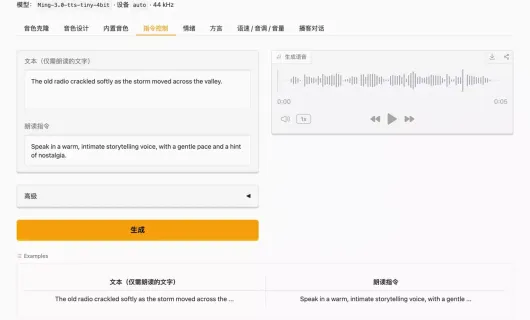
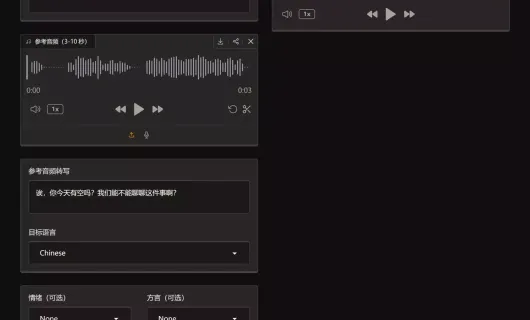
Introduction
Ming‑3.0‑tts is an open‑source text‑to‑speech (TTS) model suite developed by inclusionAI (Ant Ling), Ant Group. It is released under the MIT license, with full inference code, model weights and evaluation reports available for offline local deployment. Two variants are provided: a dense small 0.5B parameter model, and Ming‑3.0‑tts‑tiny built on the Ling V3 MoE sparse expert architecture. The tiny variant has 7.9B total parameters while activating only 1.3B during inference, balancing high audio fidelity and long‑form stability for consumer hardware. It additionally supports multi‑speaker podcast‑style dialogue generation and outputs 44.1 kHz high‑fidelity audio.
Core Functions & Features
- Director Mode (highlight feature) for fine‑grained expressive voice control Instead of rigid markup syntax, you can describe vocal delivery in plain natural language: emotion, word stress, speaking speed, pauses and tone shifts. Paralinguistic tags can be embedded in text to produce natural non‑verbal vocal effects including laughter, sighs, breaths and coughs. It delivers performative voiceovers rather than flat robotic narration, ideal for scripts, audiobooks and short video voice acting.
- Three zero‑shot voice creation workflows It ships with over one hundred native Chinese voices plus several English voices. You can select built‑in voices, generate new voices from textual descriptions of timbre, or clone a voice from a short reference audio clip. No extra fine‑tuning is required, and each line in a script can be assigned a separate speaker voice.
- Detailed supported languages & dialects for speech synthesis
✅ 7 primary languages: Mandarin Chinese, English, Japanese, Korean, French, German, Spanish
✅ 2 Chinese regional dialects: Cantonese, Sichuanese (Chuan‑Yu dialect)
Note: Stable speech synthesis in Ming‑3.0‑tts covers only the above 7 languages plus Cantonese and Sichuanese. Other dialect abilities belong to other Ming audio family models for speech recognition, not synthesis.
- Lightweight local inference with low hardware requirements The compact 0.5B dense model runs smoothly on consumer GPUs and many Mac devices. The MoE tiny variant delivers better audio quality and more consistent long‑form narration, especially for multi‑character podcast dialogue. Typical use cases include short video dubbing, audiobooks, conversational bots, game NPC voice and rapid audio prototyping.
- Robust long‑form synthesis Optimized for extended continuous text, it avoids voice drift, broken phrasing or audio degradation, suitable for synthesizing long audiobook passages in one run.
Underlying Technology
It is built on inclusionAI’s self‑developed Ling V3 MoE sparse expert architecture, following an LLM‑style autoregressive speech generation paradigm. The model takes text content, director prompts, paralinguistic tags and voice reference information as unified input and outputs complete speech waveforms end‑to‑end. The sparse MoE design retains strong expressiveness while activating only a small subset of parameters per inference, cutting memory and compute cost to enable controllable high‑quality speech synthesis locally.