

VibeVoice TTS
Highly expressive, long-form, multi-speaker conversational audio generation
Download with PC ClientFeatures
Screenshots
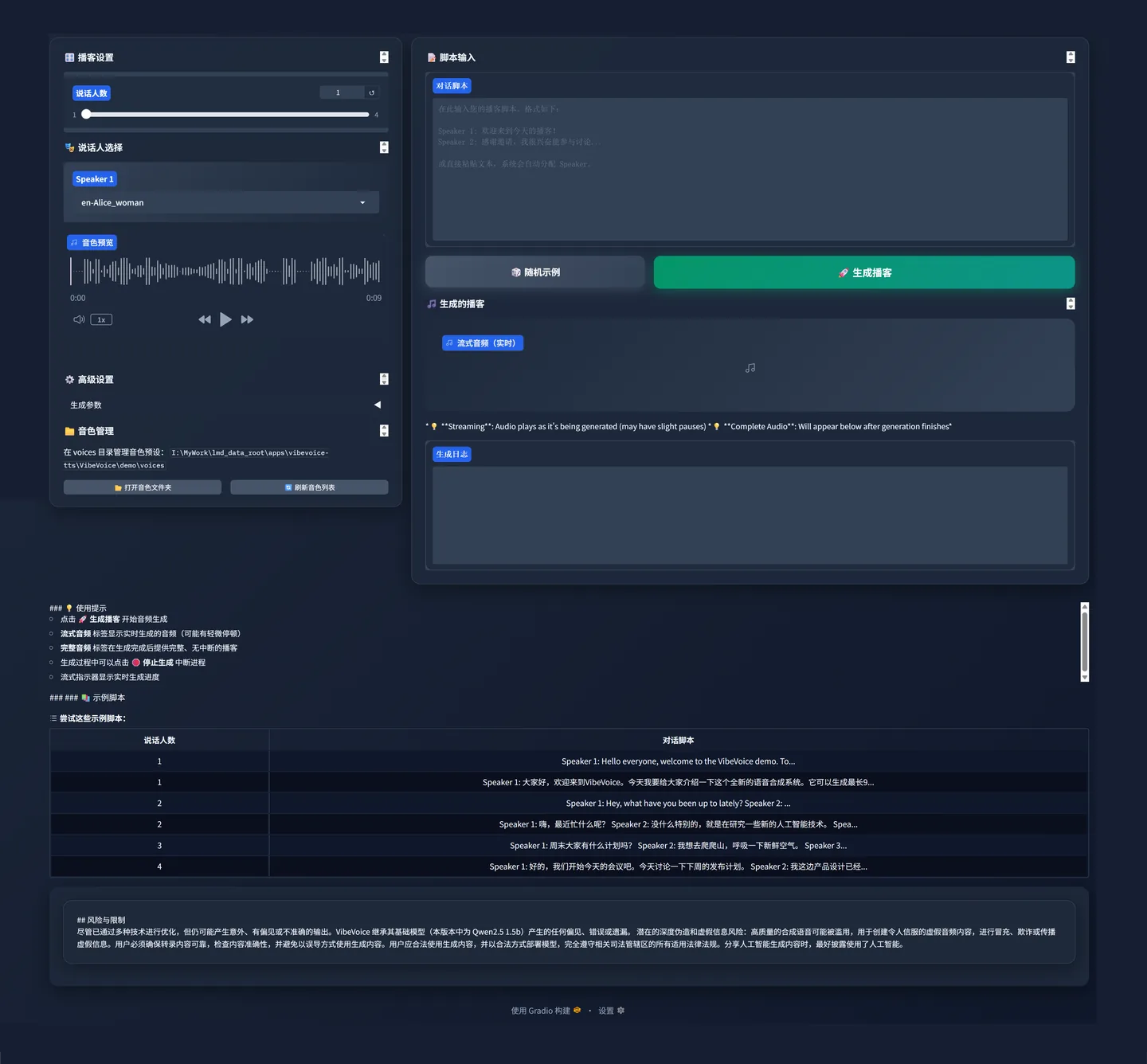
System Requirements
16GB RAM recommended. 18GB+ storage recommended.
macOS 15+: M-series chips required.
Windows 10/11 64-bit: NVIDIA GPU with 6GB+ VRAM required.
Note: For NVIDIA GPUs, install a newer driver.
Introduction
Updated Sep 29, 2026: added support for the 7B GGUF model. It reduces VRAM usage and delivers balanced quality, with noticeably faster generation on Mac M-series chips.
Note: By default, only the 1.5B model is downloaded. To use other models, simply change the option and run again — the model files will be downloaded automatically. The 7B GGUF quantized model takes up 11GB, while the original 7B model takes up 32GB.
1. What is VibeVoice?
VibeVoice is a frontier open-source Text-to-Speech (TTS) framework developed by the Microsoft research team. Unlike traditional "single-speaker, short-text" narration tools on the market, VibeVoice is an audio content creation engine specifically engineered to generate high-quality, long-form, multi-speaker conversational audio (such as AI podcasts, audiobooks, drama scripts, and multi-turn dialogues).
2. What Technologies are Under the Hood?
VibeVoice's architecture fuses today's most advanced AI concepts:
- LLM Backbone: It leverages a Large Language Model (specifically the Qwen2.5 1.5B size in its public release) to comprehend the textual context, emotional dynamics, and narrative flow just like a human reader.
- Next-Token Diffusion Framework: By integrating a lightweight diffusion-based decoding head, it predicts high-fidelity acoustic features, rendering highly realistic and detailed voice outputs.
- Ultra-low Frame Rate Tokenizers: It introduces continuous semantic and acoustic speech tokenizers operating at a mere 7.5 Hz, significantly reducing computational overhead when processing massive context lengths.
3. Product Characteristics (Pros & Cons)
✨ Key Advantages (Pros):
- Seamless Multi-Speaker Support: It can host up to 4 distinct speakers in a single audio episode. It automatically manages natural turn-taking and speaker consistency with high emotional expressiveness, capturing real conversational nuances such as sighs, sudden emotional changes, or even spontaneous humming.
- Massive Long-form Generation: Breaking free from the typical limits of traditional TTS, VibeVoice handles a context length of up to 64K tokens, enabling it to synthesize a continuous, coherent audio piece lasting up to 90 minutes in a single pass.
⚠️ Potential Drawbacks (Cons):
- Hardware Demands: Smooth local generation requires decent GPU VRAM. Running more advanced weights, such as the 7B variations, presents a steep hardware requirement for everyday consumers.
- LLM "Hallucinations": Because it is a raw LLM without rigid, traditional text normalization pipelines, it might occasionally misread rare punctuation, miss words when rushing, or unpredictably hallucinate faint background music or unintended breath noises.