Skip to content

TripoSplat
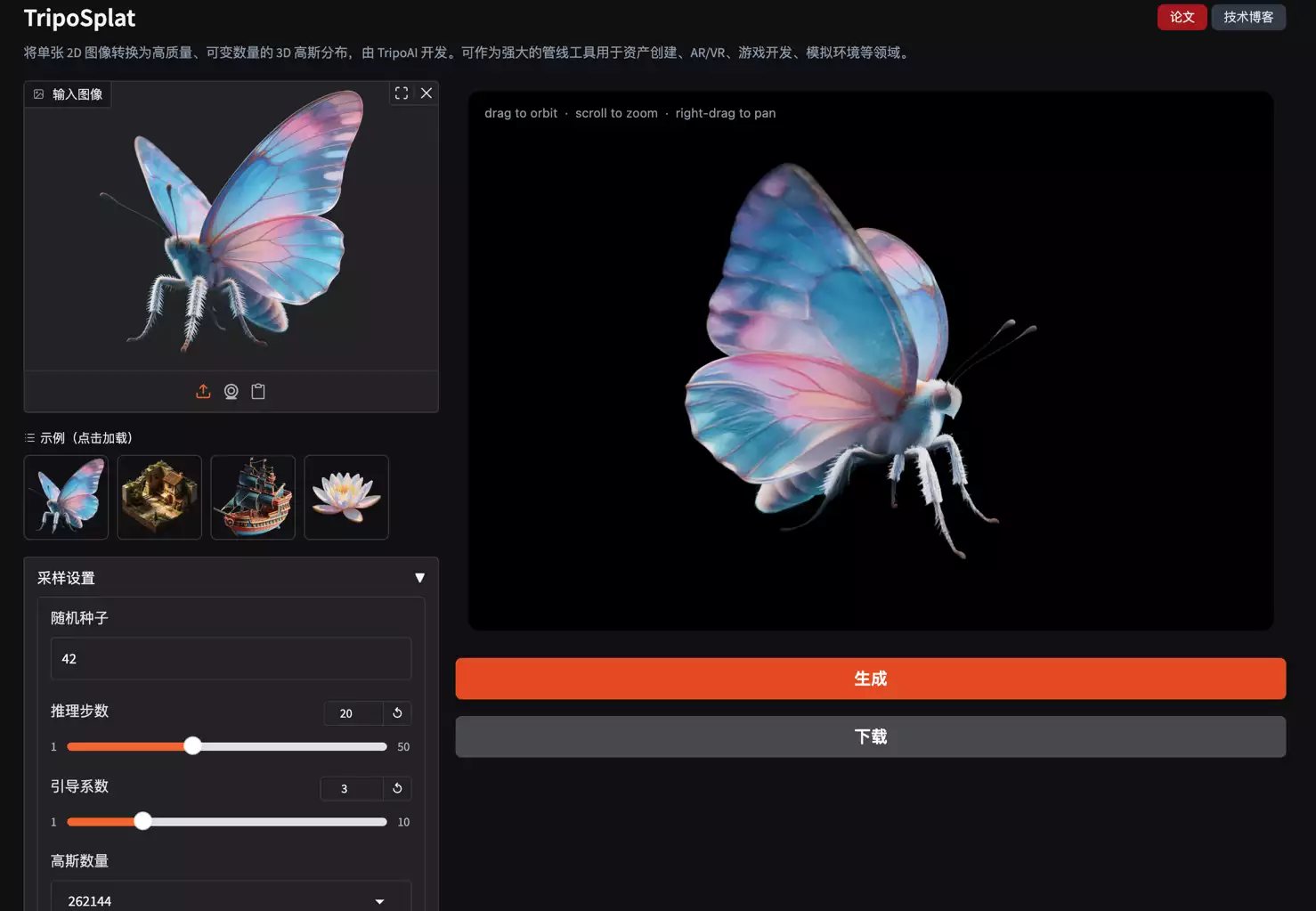
Generates lightweight interactive 3D Gaussian scenes compatible with mainstream 3D software from one single image rapidly
Download with PC ClientFeatures
Screenshots
System Requirements
16GB RAM recommended. 13GB+ storage recommended.
macOS 15+: M-series chips required.
Windows 10/11 64-bit: NVIDIA GPU with 8GB+ VRAM required.
Note: For NVIDIA GPUs, install a newer driver.
Introduction
1. Basic Project Info
TripoSplat is an open-source single-image-to-3D Gaussian Splatting project co-developed by Chinese 3D foundation model company VAST AI (VAST-AI-Research) and Tsinghua University. Its GitHub repository is https://github.com/VAST-AI-Research/TripoSplat, released under MIT license. It features lightweight code, offline local running capability, and no paid API access required.
2. Core Functions & Features (User-Friendly Version)
- Ultra-low entry barrier: Only one single 2D image (photo, illustration, product shot) is needed. No multi-angle shooting, professional camera equipment or pre-calibrated camera poses required to generate fully rotatable interactive 3D scenes.
- Ultra-fast inference: Completes one full generation within 5 seconds on GPUs above RTX 20 series. Local deployment can be finished in 5 minutes on regular PCs.
- Adaptive detail adjustment: Built-in adaptive density algorithm automatically allocates more 3D splat particles to main subjects for rich details while simplifying empty backgrounds. Users can manually tune Gaussian counts from 32K to 262,144 to balance visual quality and file size.
- Universal export formats: Natively outputs
.splatand.plyfiles, compatible with SuperSplat online viewer, Blender, Unity, Unreal Engine and other mainstream 3D tools, ready for rendering and physical simulation without extra conversion. - Fully open & free: All source codes and model weights are publicly available, supporting secondary development and integration with AI pipelines like ComfyUI.
3. Application Scenarios
- E-commerce & creative design: 3D product display, 2D artwork 3D conversion, rapid digital prototype creation;
- Game development: Fast prototyping of characters, props and small environments;
- AR & VR: Virtual exhibits, digital twins, interactive spatial assets;
- Academic simulation: Robotic environment reconstruction, vision simulation, 3D vision research;
- Individual creation: Low-cost interactive 3D scene production for hobbyists.
4. Underlying Core Technologies
- Core paradigm: Feed-forward single-image 3D Gaussian reconstruction. An end-to-end neural network jointly predicts scene geometry, texture and implicit camera poses, eliminating the need for multi-view SfM camera calibration required by traditional 3DGS.
- Model pipeline: Complete PyTorch workflow including DINOv2 image encoder, Flux2-VAE, flow-matching DiT denoiser, octree sampler and Gaussian decoder.
- Optimization algorithms: Adaptive Gaussian density control and triangle primitive rendering, producing outputs natively compatible with mesh tools and physics engines.
- Training foundation: Trained on VAST’s millions of native high-quality 3D datasets, part of the Tripo family of 3D generation models.
LicenseMIT