Skip to content

BackApp Details
IndexTTS 2.5 (Lite Version)
Use GGUF quantized model, GPU acceleration for AMD / Intel / NVIDIA, faster startup. Zero-shot TTS system by Bilibili featuring fast voice cloning, cross-lingual synthesis, precise emotion/speed control
Note: Please open in the PC Client. Go to download >>>
Features
Supported Languages
System Requirements
Minimum 16GB RAM. 10GB+ storage recommended.
macOS 15+: Supports Intel and M-series chips.
Windows 10/11: GPU acceleration (NVIDIA / AMD / Intel Arc discrete GPUs) is recommended, with more than 4GB VRAM required. Running on CPU will be slow, and some older CPUs may fail to generate audio.
Note: If you have an NVIDIA GPU with more than 8GB VRAM, you may install the original application.
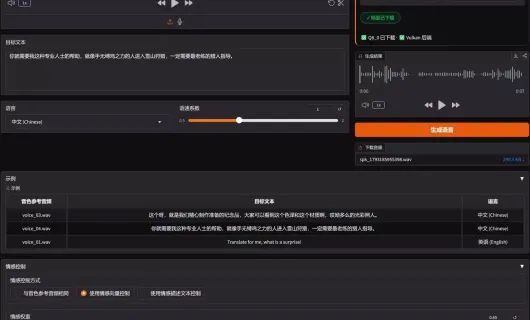
Screenshots
Introduction
Note: GGUF quantized model, slight audio quality loss. No emotion reference audio feature.
IndexTTS is an industrial-level, highly controllable, and efficient zero-shot Text-To-Speech (TTS) system. For everyday users and content creators, it acts as an intelligent "AI Voice Cloning & Dubbing Suite":
Major Upgrades in IndexTTS 2.5 vs. IndexTTS 2.0
- Expanded Multilingual Support: Adds Japanese, Spanish, and Arabic alongside Chinese and English (5 languages total) with enhanced cross-lingual voice cloning capabilities.
- Faster Inference & Higher Efficiency: Features streamlined decoding pipelines, full BF16 support, and vLLM integration, delivering significantly faster generation speeds and lower latency compared to 2.0.
- Explicit Speed Control (
duration_factor): Introduces dynamic speaking speed adjustment ranging from 0.5x to 2.0x duration. - Multi-Language Pronunciation Control: Upgrades from Chinese Pinyin-only control in 2.0 to comprehensive phonetic control across Chinese Pinyin, English CMU phonemes, and Japanese Kana.
Features & Highlights
- Zero-Shot Voice Cloning: Clones a target speaker's unique voice timbre from just a single short reference audio clip (a few seconds long).
- Expressive & Disentangled Emotion Control: Allows fine-grained emotional synthesis. You can synthesize speech with rich emotions or mix one speaker's voice identity with another person's emotional delivery (decoupling timbre from emotion). Emotion can also be directed using natural language descriptions (e.g., "speak in a panicked, whispery voice").
- Precise Speaking Speed & Rhythm Control: Adjusts synthesis speed seamlessly between 0.5x and 2.0x while maintaining accurate timing and pause placement, crucial for matching frame timings in video dubbing.
- Pronunciation Correction: Solves polyphonic or rare-word mispronunciations by allowing users to explicitly provide Pinyin (Chinese), CMU phonemes (English), or Kana (Japanese).
Developer & Practical Applications
- Developing Team: Developed and open-sourced by Bilibili's IndexTeam / Speech Team.
- Target Applications:
- Video Dubbing & Content Creation: Voiceovers for anime, movies, short videos, and game characters.
- Audiobooks & Podcasts: Automated generation of expressive, multi-character narration.
- Virtual Humans & AI Assistants: Low-latency, natural-sounding voice generation for interactive avatars.
- Cross-Lingual Localization: Transferring a speaker's voice print to synthesize native speech in a different language.
Underlying Technologies
IndexTTS leverages a state-of-the-art autoregressive large model paradigm:
- Model Architecture: Built around an ~0.8B parameter GPT-style autoregressive backbone, integrated with a Flow-Matching speech-to-mel decoder and a BigVGAN high-fidelity neural vocoder.
- Disentanglement & Emotion Control: Implements specialized feature disentanglement to isolate timbre from emotional representations, leveraging LLM-based soft instruction mechanisms (fine-tuned Qwen) for prompt-guided emotion synthesis.
- Acoustic & Phonetic Modeling: Uses hybrid character-phoneme modeling alongside semantic codecs (MaskGCT), w2v-bert-2.0, and CAMPPlus speaker embedding extraction to minimize Word Error Rate (WER) and boost audio naturalness.
- Inference Optimization: Optimized for production environments with support for BF16/FP16 precision, DeepSpeed acceleration, and high-throughput vLLM serving.
Licensebilibili Model Use License Agreement